
Group Insurance: The Business line in Insurance That Still Runs on Spreadsheets
If there is one segment of the insurance industry that quietly underpins the financial security of the working world, it is group insurance. Employer-sponsored health, life, and disability coverage collectively form the backbone of how most people access financial protection, not through individual policies they sought out, but through the workplace.
The numbers reflect just how dominant this segment has become. The global group insurance market generated $1,024.6 billion (approx. ₹96.88 trillion) in total premium volume in 2025 and is projected to reach $1,842.3 billion (approx. ₹174.19 trillion) by 2034, expanding at a compound annual growth rate (CAGR) of 6.8%. Health insurance alone accounts for nearly 38% of that market, making it the single largest product category within the segment. In terms of daily engagement and market share within the group segment, no other line of insurance touches as many lives or drives as much consistent premium activity as group health.
The demand side of this equation has also been evolving. A 2022 Deloitte survey of over 200 brokers found that employers are no longer looking at group benefits as a cost-to-minimise line item. Post-pandemic, 92% of large and midsize employers expanded mental health support, 74% added new leave options, and 75% introduced new benefit types altogether.
The Operational Reality
Despite the scale, and despite years of incremental technology investment in policy administration and claims, the core underwriting workflow in group insurance remains largely manual. A typical renewal or new business quote arrives as a broker-submitted package of a mix of Excel sheets, PDFs, and email threads, each formatted differently depending on the intermediary. The underwriting team must manually extract member demographics, reconcile claims experience across prior policy periods, interpret benefit terms buried in dense document annexures, and then build a pricing model from scratch, or close to it.
As a result, renewal seasons are significantly strained and errors in manual data extraction or pricing assumptions have real downstream consequences on claims ratios and profitability.
As Group Products become complex with multiple pick and choose covers, this adds substantially to the underwriter workload in comparing pricing with previous benefits.
The Cost of Underwriting
Milliman's 2024 Group Health Rating and Underwriting Survey, the most rigorous primary source on Indian group health underwriting practice, reports that an underwriting team in manual environments process approximately 175-200 quotes per FTE per month. Critically, the same survey confirms that approximately two-thirds of respondents use no automated software for group health underwriting at all.
At 200 quotes per month across 225 working hours, an underwriter's active time per quote is approximately 1 hour 7 minutes. Adding intake, data extraction, validation, pricing, and iteration, and manual operational tasks, the full-cycle time per quote sits at approximately 3 hours.
The time-value cost per group health quote in a mid-tier insurance company is ₹1,731, and the success ratio is < 2%.
By utilizing Intelligent Document Processing (IDP) to instantly ingest multi-format files, Kazunov 1AI achieves a 10X processing capability increase that completely bypasses the above mentioned manual ingestion lag. Applying the same cost structure to Kazunov 1AI's 5-minute processing time, the manual time-value cost alone drops to ₹48 per quote, a 97% reduction in underwriter time cost, before accounting for platform economics.
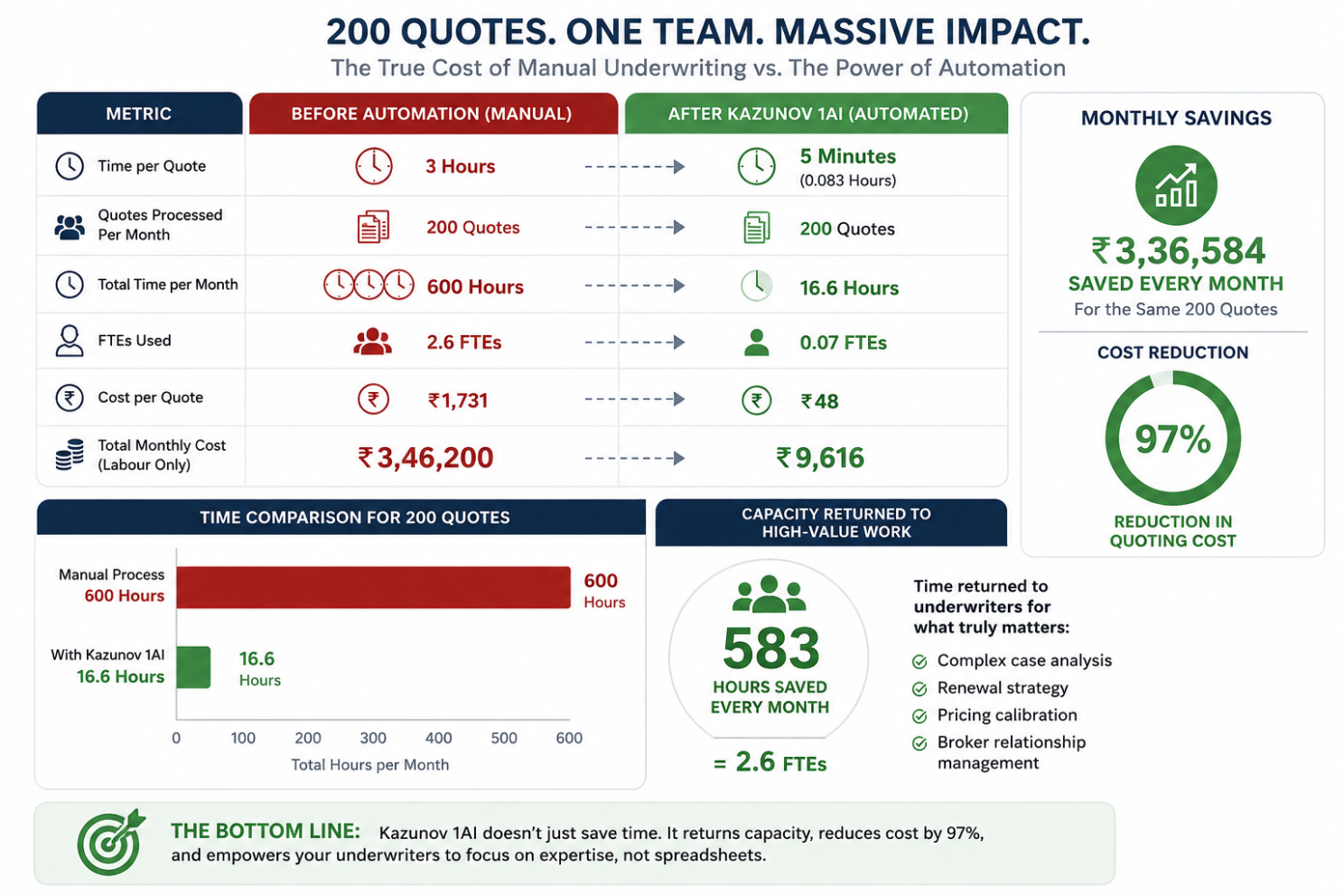
This shift means a month’s worth of manual volume is processed in a mere two days. The reclaimed bandwidth unlocks a 13.5x multiplier on human output for standard submissions, redirected for the team to address actual risk assessment, complex case handling, and new business development.
Where the Opportunity Sits
The current operational architecture was not built for the product complexity or data volume that group insurance now demands. This is precisely where Kazunov 1AI makes a material difference, compressing turnaround from days to hours without sacrificing the precision that group underwriting requires. It does so by:
- GenAI based Classifier & Extraction: Ingesting broker submissions via various file types (PDFs, Excel, CSVs), nomenclatures, data types, and identifying product categories (GHI/GPA) to eliminate manual format normalization.
- Policy & Risk Input Summary: Mapping policy-level terms and historical claims while evaluating risk indicators like data integrity and claim trends.
- Demographic & Risk Stratification: Cleaning raw claim data into precise age brackets while isolating high-payout diseases and cost drivers.
- Risk Pricing & Burn Sheet/ Rack-rate Pricing Automation: Calculating pricing math directly from extracted claims data to let underwriters alter variables and view premium updates in real time.
- Quote Version Control Management: Tracking multiple quote iterations and dynamic assumption updates in parallel.
- Underwriter Dashboard Governance: Enforcing role-based approval rights across team hierarchies to move finalized figures through secure gates for a digitally signed PDF summary.
The market is large, product sets are growing in complexity, and the operational gap is well-documented. Platforms purpose-built for this layer of the problem, like Kazunov 1AI, are designed specifically to transform this heterogeneous, high-stakes data environment into a competitive advantage.
[1] Group Insurance Market Research Report 2034
(Note: Conversions are based on the current exchange rate of approximately ₹94.55 per USD as of May 6, 2026.)
[2] Strategies for Driving Growth in Group Insurance | Deloitte US
[3] Milliman's Survey on Group Underwriting
[4] Insurance productivity 2030 | McKinsey
[5] Underwriter Group Health Salary in India (2026) - ERI SalaryExpert
Related Blog
Other Blog.webp)
Insurance for All. AI Driving India's vision for Viksit Bharat 2047
Insurance for all remains a critical national priority. Yet penetration remains very low, limiting financial resilience.
.webp)
Evolution of Technology in Insurance: From Automation to Intelligence
Technology adoption in insurance has been maturing through structured capability building, moving from automation to intelligence.
.webp)
AI in Health Insurance Isn't Just About Automation- It's About Understanding Health
AI in health insurance is evolving fast, but its true potential lies in how effectively it integrates intelligence from the healthcare ecosystem.